
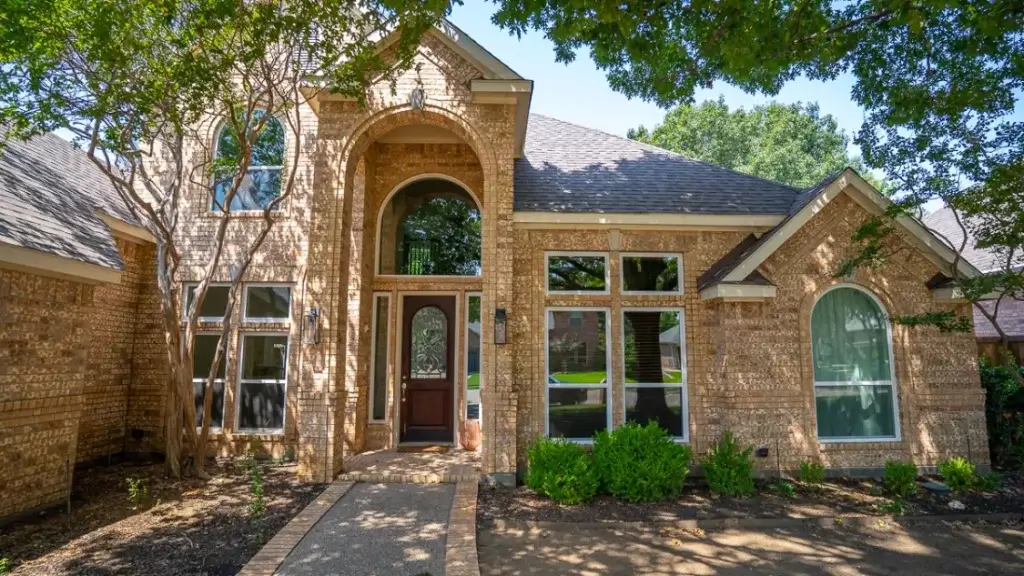
Start with your home’s architectural style, then coordinate the window type, frame material, frame color, and grille pattern so the windows look built-in rather than added-on. Match a ranch with wide sliders, a colonial with grid-topped double-hungs, and a modern home with slim black casements — for DFW homes, style-first choices read as original.
Key Takeaways
- Style comes first. Identify your home’s architecture — ranch, colonial, craftsman, modern, or Tudor — before you shop, because it dictates which window types and proportions belong there.
- Four variables have to agree. Window style, frame material, frame color, and grille pattern all reinforce one look; miss one and the others can’t rescue it.
- Match what’s there unless there’s a reason not to. For most DFW colonials, replacing like-for-like is the safest call.
- Frame color plays off the brick. White and almond read traditional; black and dark bronze read modern; earth tones blend with buff brick.
- Grilles signal the era. Colonial grids for traditional homes, prairie grids for craftsman, diamond grids for Tudor, clean-lite for modern.
- Keep the front elevation consistent and check HOA rules before changing style or color in most Collin County communities.
What Does It Actually Mean for Windows to “Match” Your Home?
Windows “match” your home when the style, frame material, frame color, and grille pattern all point to the same design intention — not when a single swatch happens to look nice. It’s visual coherence across four variables at once, judged from the street.
A white double-hung window with colonial grids looks perfectly at home on a traditional brick colonial in Frisco. Put that same window on a modern transitional home in Prosper, and it looks like a mistake. Swap the grids for a clean-lite version and keep the white frame, and it’s still wrong; the frame profile is too chunky for the aesthetic. Get the style and profile right, but choose the wrong brick tone, and you’re close but not quite there.
Matching actually means every element is reinforcing the same design intention.
Why Does Architectural Style Matter Before You Pick a Window?
Your home’s architectural style is the starting point because it tells you what window types and proportions belong there in the first place. In DFW suburbs, you’re mostly working with four categories:
Traditional brick colonial: The dominant style across Frisco, McKinney, and Plano subdivisions built in the ’90s and 2000s. Tall, symmetrical windows. Double-hung is the standard. Colonial grids are common. White or almond frames are the default.
Ranch and mid-century: Lower rooflines, horizontal emphasis. Horizontal sliders fit the proportions. Grid-free or minimal grille treatment suits the aesthetic. Dark frames read well here.
Craftsman and bungalow: More character detailing, tapered columns, natural material tones. Casement windows suit this style. Prairie grids are the period-correct choice.
Modern and transitional: Clean lines, larger glass areas, minimal ornamentation. Casements and picture windows with no grilles. Black and dark bronze frames are the current go-to. Slim profiles matter here more than anywhere else.
Most DFW homeowners fall into the first category. The good news is that traditional brick colonials are forgiving: several window styles work, and you have a wide range of colors to play with. The bad news is that there are also several ways to get it wrong.
Window Styles by Architectural Style: A Quick Reference
Use this table to match your house type to window style, grille pattern, and frame finish at a glance. It’s a starting point for the on-site conversation — your brick tone and elevation may nudge a choice one way or the other.
| Home Style | Best Window Type(s) | Grille Pattern | Frame Color/Finish |
| Ranch / Mid-Century | Wide sliders, picture, casement | None or minimal | Neutral; bronze/black for modern-ranch |
| Colonial | Double-hung | 6-over-6 colonial grids | White / cream |
| Craftsman | Casement; double-hung with divided upper sash | Prairie / rectangular | Wood-tone / earthy |
| Modern / Contemporary | Casement, picture, large fixed | None | Black / bronze / dark gray |
| Tudor | Clustered casements | Diamond grids | Dark / black |
How Do You Choose the Right Window Style for Your Home’s Design?
For most DFW homeowners, the answer is: replace with what’s already there. If you have double-hung windows and the house is a traditional colonial, putting in double-hung replacements is almost always the right call. You’re replacing the unit, not reinventing the architecture.
Switching window styles can make sense, but only if there’s a reason. Adding casements to a craftsman remodel works because it aligns with the architectural language. Mixing horizontal sliders into a traditional brick colonial creates visual chaos because horizontal and vertical emphasis don’t coexist peacefully on the same elevation.
The cases where style changes genuinely improve things:
- Casements on a craftsman or modern remodel: better sightlines, better ventilation, correct aesthetic
- Picture windows on rear elevations: clean look, maximum glass area, where curb appeal isn’t the priority
- Specialty shapes to accent a gable or entry: arched or geometric windows as intentional focal points
When in doubt, match what’s there. Save the design ambition for interior renovations where a mismatch doesn’t face the street.
Does Changing Window Styles Affect the Installation Process?
Yes, and more than most people expect. Different styles may require modifications, so planning ensures a smooth process. A straight replacement (same style, same rough opening) is relatively clean. You’re pulling the old unit and setting the new one in the existing frame or opening.
Switching styles often means a different rough opening size, additional trim work, and sometimes modifications to the framing or exterior finish. That’s a scope change. It requires someone who’s looked at the wall before the window was ordered, not someone who sets a window in a box on your doorstep and hopes it fits.
This is one of the more consistent failure points with install-only arrangements or big-box purchases: the design decision gets made without the installation expertise in the room. By the time a mismatch surfaces, the window is already ordered.
This is exactly why our full-scope window replacement and installation keeps the design decision and the field measurement under one roof.
How Do Frame Material and Color Affect Curb Appeal?
Frame material determines two things: what colors are available to you, and what the frame profile looks like.
Vinyl Frames
Vinyl is the most common frame material in DFW and the most budget-friendly option. Burris and NT Windows are the workhorses here, solid performers across the standard color range: white, almond, tan, clay, and bronze. The tradeoffs are wider frame profiles, which reduce visible glass area and read as heavier, and a more limited palette if you want something outside the standard offerings.
If custom color is a priority, NT Windows’ VividColor finishes significantly expand what’s available: Midnight, Sage Green, Bordeaux, and a range of earth tones among them. Worth knowing if you need something that isn’t white, almond, or bronze.
Fiberglass Frames
Fiberglass (Pella Impervia) offers slimmer profiles and more color options (including true black), and holds up better in Texas heat over the long term. Meanwhile, Pella’s wood-clad line (Lifestyle) gives you the genuine profile and finish of wood without the upkeep. For modern and transitional homes where the slim profile and dark color are part of the aesthetic, fiberglass can be a good fit.
What Frame Colors Work Best on DFW Brick Homes?
Brick is everywhere in North Texas, and the brick tone is the primary color relationship to manage.
White and almond read traditional and clean against most brick tones. Safe choices that work because they’ve always worked on this housing stock. If the house is a conventional Frisco or McKinney brick colonial and you don’t want to make a statement, white or almond is a reliable call.
Black and dark bronze create contrast and suit modern aesthetic remodels or homes with updated exteriors. Against red or buff brick, black reads bold, which is the point. Against dark brick, it can blend in ways that look intentional or muddy depending on the specific tones involved.
Warm earth tones (tan, clay, adobe) tend to blend naturally with buff or light brick. Less visual contrast, more cohesion. A good choice when the goal is windows that feel like they’ve always been there.
For a closer look at how different window styles complement North Texas brick homes, see our best window types for brick homes guide.
What Are the Right Grille Patterns for Different Home Styles?
Grilles are one of those decisions that homeowners underestimate until they see the finished product and realize the grid pattern is wrong for the house. There are three main configurations to know:
Colonial grids (6-over-6, 9-over-9, etc.) divide the glass into smaller rectangular panes, the standard for traditional architecture. If your home has a colonial aesthetic, this is almost certainly the right answer.
Prairie grids put the grille bars only at the perimeter of the glass, leaving the center open. This is the signature look for craftsman and bungalow styles, and it’s distinctive enough that it reads wrong on a traditional colonial.
Homes without grilles feature clean-lite glass. This is the right choice for modern and transitional homes. It’s also common on rear-facing windows, even in traditional homes where the priority is the view rather than curb appeal.
On SDLs, most replacement projects use simulated divided lights: grille bars set on the glass surface rather than true divided-light construction. For practical purposes, they look nearly identical and are significantly more cost-effective. The alternative is grilles between the glass, which sit inside the IGU and are easier to keep clean. Both are legitimate choices; SDL is just what most homeowners end up with.
For a deeper look at grille types and the muntins vs. mullions question, visit our window muntins guide, which covers it thoroughly.
Should Every Window in the House Have the Same Grid Pattern?
Front elevation: Yes. Keeping the same grid pattern across the front of your home creates a cohesive appearance from the street. Mixing grid styles on the front elevation tends to look unintentional rather than like a deliberate design choice.
Rear elevation: You have more flexibility. Many homeowners go grid-free on back windows because clean sightlines matter more than curb appeal from the backyard. It’s a common and perfectly reasonable choice.
If you’re in an HOA community (and many DFW suburbs are), check your documents before making this call. Some communities require consistency across all elevations, not just the front. Stonebridge Ranch, Craig Ranch, and similar communities in Collin County have style and color requirements. The specifics vary by community and shouldn’t be assumed. Bring your HOA documents to the consultation, and we can tell you exactly what’s in play.
Window Type Glossary: A Quick Reference
Here’s what each window type actually does, so the style names in this guide translate into the right pick for each opening.
- Double-hung: Two sashes that both slide vertically. The traditional colonial default, and the easiest to clean because the top sash tilts in.
- Casement: Hinged on the side and cranked outward like a door. Slim frames, unobstructed glass, and the best air seal — a natural fit for craftsman and modern homes.
- Picture: A large fixed pane that doesn’t open. Maximum glass and view; ideal on rear elevations and as the center of a grouping.
- Bay / bow: A projecting cluster of windows that adds depth and interior sill space — a bay uses three angled units, a bow uses four or more gently curved ones.
- Slider: One or more sashes that glide horizontally. The horizontal emphasis suits ranch and mid-century proportions.
- Awning: Hinged at the top and cranked outward at the bottom, so it sheds rain while open — useful over kitchen counters, in bathrooms, and paired above or below fixed glass.
For the energy-performance side of each type — U-factor, solar heat gain, and glazing — the U.S. Department of Energy’s Window Types and Technologies guide is a solid, non-commercial reference.
Interior vs. Exterior Finish (Two-Tone Frames)
Two-tone frames let you run one color outside and a different one inside, so the window serves the elevation and the room at the same time. The classic North Texas combination is a black or dark-bronze exterior for modern curb appeal with a white or wood-tone interior that keeps rooms bright and neutral.
This matters because the color that flatters your brick isn’t always the color you want framing the view from your sofa. Fiberglass and wood-clad lines offer the widest two-tone range; standard vinyl is more limited but still covers the common pairings. Decide the exterior color off the brick and the interior color off your trim and cabinetry, and confirm the exact combination is available in the product line before you order.
Custom Sizes and Specialty Shapes
If your openings aren’t standard — or the architecture calls for something beyond a rectangle — custom sizing keeps the design intact instead of forcing a compromise. Arched transoms over an entry, half-rounds and quarter-rounds in a gable, octagons, and trapezoids that follow a vaulted ceiling are all made to order.
The rule is the same as everywhere else: specialty shapes should reinforce the style, not fight it. A round-top window over a colonial front door reads as intentional; the same shape on a low ranch does not. When an opening needs a non-standard size or a specialty profile, our custom window shapes and sizes service handles the measuring, ordering, and trim so the finished window looks original to the house.
HOA and Architectural-Review Considerations
Before you finalize a window style, frame material, or color change, check whether your HOA requires architectural-review approval — in most DFW master-planned communities, it does. Changes visible from the street (style, grille pattern, and frame color especially) are the ones most likely to need sign-off, and approval usually has to happen before the windows are ordered, not after they’re installed.
Start with your CC&Rs and the community’s architectural guidelines; a neutral primer like the Homeowners Protection Bureau’s guide to HOA rules and regulations explains how these review processes typically work. Then bring your HOA documents to the consultation. Because we’ve worked across Collin County communities, we can usually tell you what a given neighborhood expects and help you avoid ordering a window that review would reject. Choosing an installer who handles this well is part of how to choose a window replacement company in the first place.
Keeping Windows Consistent Across the Home
Consistency is what makes a whole-home replacement read as a single design rather than a patchwork of decisions. The most reliable approach: lock the style, frame color, and grille pattern for every street-facing window first, then allow controlled variation — grid-free glass, picture windows — only where the elevation isn’t visible from the curb.
If you’re phasing the project over more than one season, record the exact product line, color name, grille profile, and glass package so later windows match the first ones precisely. Small drifts — a slightly different white, a wider grille bar — are obvious side by side. Documenting the spec up front is the cheapest way to keep a phased project looking like it was done all at once.
How Does Woodruff Help You Get the Design Decision Right?
We’ve been doing windows and doors in DFW since 1982. That’s not a footnote. It means thousands of installs inform the design conversation you have with us across Frisco, McKinney, Plano, Allen, and Prosper. We’ve seen what works on North Texas brick and what doesn’t. We know which HOA communities have restrictions and what they typically require.
The free consultation includes an on-site review of your existing exterior, examining frame materials, trim profiles, brick tone, and current grid pattern before any recommendations are made. We’re not handing you a brochure and asking you to figure it out. We’re looking at the house. When you’re ready to move forward, pricing runs $1,000–$2,200 per window fully installed depending on product, size, and complexity, with whole-home replacement typically falling between $10,000 and $40,000. Lead time from signing to installation is three weeks, with a maximum of eight.
Our Certified Woodruff contractors who work exclusively for us handle measurement, installation, exterior trim when needed, exterior paint matching, window stool replacement when needed, and blind removal and reinstallation. That full scope is included in the quoted price, which is why the design decision you make during the consultation actually translates into the finished product looking right. A lot can go wrong between the showroom choice and the finished installation. That’s the part we control.
Ready to figure out what actually works on your home? Schedule a free consultation at woodruffwindows.com or reach out through our custom windows service page.
Frequently Asked Questions
What window style matches a ranch home?
Wide horizontal sliders, picture windows, and casements match a ranch home best because they echo its low, horizontal rooflines. Skip busy grids — go grid-free or minimal — and choose neutral frames, or bronze/black for a modern-ranch look.
What windows suit a colonial home?
Double-hung windows suit a colonial home. Pair them with 6-over-6 (or 9-over-9) colonial grids and white or cream frames to reinforce the symmetrical, traditional facade common across Frisco, McKinney, and Plano.
What windows fit a craftsman home?
Casements and double-hungs with a divided upper sash fit a craftsman home. Use prairie or rectangular grille patterns and wood-tone or earthy frame finishes to match the style’s natural-material detailing.
What windows work for a Tudor home?
Clustered casement windows work for a Tudor home, ideally with diamond-grid grilles and dark or black frames. The tall, grouped casements and steep diamond patterns echo Tudor’s storybook proportions.
SDL vs. GBG grilles — which looks more authentic?
SDL (simulated divided lite) looks more authentic because the muntin bars sit on the glass surface and cast the shadow lines and depth of true divided-light windows. GBG (grilles between the glass) looks flatter but is easier to clean because the glass surface stays smooth.
Do I need HOA approval to change my window style or frame color?
Often, yes. Many DFW HOAs require architectural-review approval before you change window style, frame material, or color — especially on street-facing elevations. Check your CC&Rs and submit for approval before ordering, not after installation.
Should every window in my house match?
Front-facing windows should match for a cohesive street view. Rear and side windows can vary — many homeowners go grid-free in back for cleaner sightlines — unless your HOA requires consistency across all elevations.


