How do you choose a window replacement company? Verify the company carries general liability insurance and workers’ compensation, confirm your windows will be installed by in-house employees rather than subcontracted crews, compare two to three written quotes, read the fine print on both the product and labor warranties, and check verified reviews before you sign. Then watch for the two clearest warning signs of a bad fit: high-pressure sales tactics and a lowball bid. For DFW homeowners searching for a window replacement company near me, that short checklist filters out most of the risk before a crew ever touches your walls.
Key Takeaways
- Texas has no statewide contractor license, so verifying liability insurance, workers’ comp, and local reputation matters more than looking up a license number.
- The installer matters as much as the window—confirm in-house vs. subcontracted installers before you sign.
- Get two to three written quotes that spell out products, labor, finish work, timeline, and payment terms.
- A complete window replacement warranty covers the product, the labor, and the glass seal—and ideally transfers to the next homeowner.
- Never pay in full up front; the FTC suggests keeping your deposit to roughly one-third of the project.
- The biggest window replacement red flags are hostage-style sales presentations, fake “today only” discounts, and bids far below everyone else’s.
- Woodruff Windows has served the Dallas–Fort Worth area since 1982 with certified, in-house installers—never subcontractors.
Why Does the Company You Choose Matter More Than the Window?
The company matters more than the window because even the best window fails when it’s installed poorly—installation is what determines the comfort, efficiency, and warranty coverage you actually receive.
A great window installed poorly is just an expensive way to end up with a bad window. Installation determines whether you actually get the comfort, energy savings, and longevity you’re paying for. A window with the best Low-E glass and the tightest seals on the showroom floor will still leak air, fog up early, or void its warranty if the crew that shows up doesn’t flash it, shim it, or seal it correctly.
This is the part most homeowners don’t think to evaluate because most of us aren’t trained to spot poor installation until it’s already a problem. You’re not just buying a product. You’re buying the skill of the person putting it in your wall, which is a strange thing to shop for when the brochure only talks about the glass.
What Happens When Windows Are Installed Poorly?
Poor installation shows up in ways that are easy to miss at first and expensive later. Air and water can leak around improperly sealed frames, driving up energy bills and inviting moisture damage behind the wall. Callbacks become the norm rather than a rare exception, and you start to recognize the installer’s truck a little too well. In many cases, sloppy installation voids the manufacturer’s warranty entirely, since most warranties require the window to be installed according to spec. You can end up with a premium product and zero coverage to show for it, which is the worst kind of expensive.
Poor sealing and flashing can even let moisture reach the surrounding structure; it’s worth understanding whether window installation can damage your walls or siding and how proper technique prevents it. Because so much of a window’s real-world performance rides on the install, ENERGY STAR stresses that proper installation matters as much as the product’s efficiency rating.
What Should You Look for in a Window Replacement Company?
Look for proof of insurance, in-house certified installers, transferable warranties, itemized written quotes, and a long, verifiable local track record.
How Important Are Reviews and Local Reputation?
Start with Google reviews and the Better Business Bureau, but read past the star rating. Look specifically for mentions of installation quality, how the company communicated during the project, and whether they followed through after the installation. A company with hundreds of five-star reviews about friendly salespeople but nothing about the actual work isn’t telling you what you need to know. Charm gets you through the sales call, not through twenty years of Texas summers.
Pay attention to how long the company has operated in your specific area, too. A national franchise with a regional call center can disappear from your local market the moment corporate decides it’s not profitable enough, and good luck getting that call center to remember who you are. A company that’s been doing this in your community for decades has a track record you can actually verify and a reputation it has to protect. A local window company with that kind of history has more to lose by cutting corners than a name you only recognize from a truck wrap.
Who Will Actually Be Installing Your Windows?
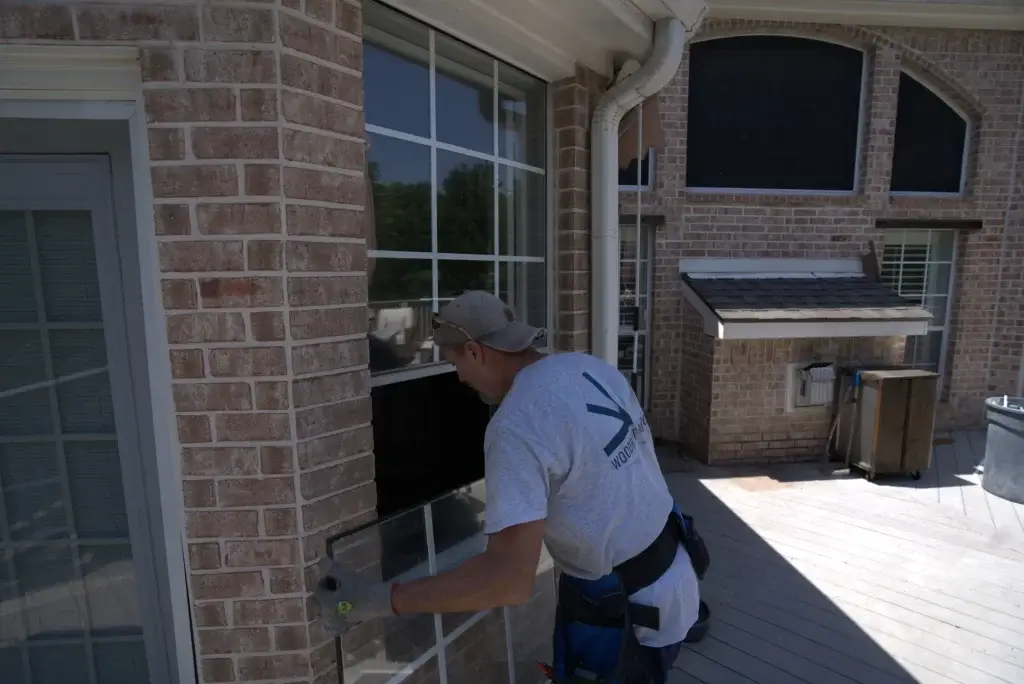
This is the single most important question you can ask, and most homeowners never think to ask it. Ask whether the people doing the work are certified window installers employed directly by the company, or subcontracted day labor you’ve never met, and the company barely knows either.
When the same team handles measurement during installation, accuracy improves, and accountability stays in place. When a company subcontracts out the labor to keep costs down, you lose visibility into who’s actually doing the work, what training they have, and who you call when something goes wrong. Ask the question directly. A company with nothing to hide will give you a straight answer, not a vague gesture toward “our trusted partners.”
Licensing, Insurance, and Bonding
To confirm a window company is legitimate in Texas, verify its insurance—because there’s no state license to check. Texas issues no statewide contractor license for window replacement, so the responsibility falls on you to make sure a window installer is licensed and insured the way it counts.
Ask for a current certificate of general liability insurance and proof of active workers’ compensation coverage, then call the carrier to confirm both are in force. Liability insurance protects your home if something is damaged during the job; workers’ comp protects you from a claim if an installer is injured on your property. If a company can’t produce both on request, that’s your answer.
Bonding adds another layer of protection—a surety bond gives you a path to recover funds if the work is abandoned or left incomplete. Before you hand over a deposit, read the FTC’s guidance on how to avoid a home improvement scam. And for a plain-language overview of your rights as a Texas homeowner—including the fact that the state licenses no general contractors—the neutral resource at TexasLawHelp is a good place to start.
Manufacturer Certifications
The right certifications tell you a company has been trained to install the specific windows it sells. Look for an industry credential such as AAMA InstallationMasters, which certifies that a crew installs windows to manufacturer specification—the same standard most product warranties require.
Just as important, ask whether the company is factory-certified for the brands it actually carries. A company that installs Pella, NT Windows, and Burris should be certified by those manufacturers to install their products, because factory training is what keeps your warranty intact. A certification for a brand the company doesn’t stock does you no good—match the credential to the product going into your wall.
In-House Crews vs. Subcontractors
The choice between in-house vs. subcontracted installers is the difference between one accountable team and a rotating cast you never meet. In-house crews are employees the company trains, insures, and stands behind; subcontractors are hired job-to-job to keep labor costs down, which means training and accountability vary from house to house.
When the same company that sold you the windows also employs the people installing them, there’s no finger-pointing if something needs to be fixed—one number to call, one company responsible. This is where Woodruff Windows is built differently. Family-owned since 1982, we install every window with Certified Woodruff Contractors on our own payroll—never subcontracted day labor. That’s a large part of why homeowners choose us, and it’s the first thing we’d tell you to verify about any window replacement company you’re considering.
What Questions Should You Ask Before Signing Anything?
Questions to ask window companies before you sign anything are what separate a real quote from a sales pitch. Ask what the warranty actually covers: the manufacturer’s product warranty differs from the company’s labor or installation warranty, and you want to know what each covers, how long it lasts, and whether it transfers if you sell your home.
Ask what’s included in the price beyond the window itself. Exterior trim work, paint touch-up, window stool replacement, and blind removal and reinstallation are all real labor costs that some companies quietly leave off the quote, then charge for later or expect you to handle yourself, usually around the time you’re standing in your living room with a paintbrush. Ask about the timeline from signing to installation, and get it in writing. And ask whether the number on your quote is the amount you’ll actually pay or an “estimate” that tends to grow once the crew shows up.
What Should a Written Quote Actually Include?
A trustworthy quote spells out the exact products being installed, the full scope of labor, any finish work, such as trim and paint, the projected timeline, and the payment terms, all in writing. If a salesperson tells you something verbally that isn’t reflected in the written quote, that promise doesn’t exist as far as your contract is concerned, no matter how sincerely it was delivered. Be especially wary of quotes that bundle “installation” as a single vague line item with no breakdown of what’s actually covered. That vagueness is often where the surprises live.
Questions To Ask Before You Sign
These are the questions to ask a window replacement contractor before you sign anything. A trustworthy company answers every one directly and puts the answers in writing.
- Can you provide current certificates of general liability insurance and workers’ compensation?
- Are the installers your own employees, or subcontracted crews?
- What certifications do your installers hold, and are you factory-certified for the brands you carry?
- What does the warranty cover—product, labor, and glass—and does it transfer if I sell my home?
- Is this quote a fixed price or an estimate that can change once work begins?
- What finish work is included: trim, paint, window stool replacement, and blind removal and reinstall?
- How large a deposit do you require, and what is the payment schedule?
- What is the timeline from signing to installation, in writing?
- How long have you operated in the DFW area, and can I see recent local reviews?
How To Compare Window Replacement Companies at a Glance
Use this table to compare window replacement quotes side by side, what a strong company looks like on each criterion, and the red flag that should give you pause.
| Criterion | What Good Looks Like | Red Flag |
| Licensing & Insurance | Provides current liability and workers’ comp certificates on request | Can’t or won’t show proof of coverage |
| Installers (In-House vs. Sub) | Certified employees on the company’s own payroll | Subcontracted day labor or vague “trusted partners” |
| Warranty | Product, labor, and glass coverage in writing—ideally transferable | Verbal promises or “installation” with no written terms |
| Quotes | Itemized, fixed price covering products, labor, and finish work | Single vague line item or an “estimate” that grows later |
| Reviews & Reputation | Decades of verifiable local reviews about installation quality | Thin history, franchise call center, or only sales-team praise |
| Sales Approach | Honest pricing and a no-pressure, free consultation | Marathon pitches, fake discounts, and countdown-clock urgency |
What Are the Red Flags To Watch Out For?
Some warning signs are loud enough that you should walk the moment you see them. The six-hour, hostage-style sales presentation is one of them. If a company needs that many hours in your living room to convince you, that’s a tell about the product, not a sign of thoroughness, and you’re allowed to want your evening back.
Fake discounts are another. If a quote shows your windows “marked down” from some inflated number to a “special today only” price, that original number was never real. It’s a number invented to make the discount seem bigger, and reputable companies don’t need that trick because their pricing has been honest from the start. Countdown-clock urgency, “this price expires when I leave,” works the same way: it’s designed to short-circuit your judgment, not earn your trust, and windows are not a flash sale.
Vague or evasive answers about who’s doing the labor are a red flag, too, especially after you’ve already learned why that question matters. If a salesperson dodges it or gives you a different answer each time you ask, take that seriously.
Does the Lowest Bid Actually Save You Money?
Not always, and often not at all. A bid that comes in well below everyone else’s usually means something got cut to hit that number: uncertified or subcontracted labor, lower-grade materials, or finish work like trim and paint left entirely off the scope. Those costs don’t disappear. They show up later as a separate bill, a callback, or a window that needs replacing again sooner than it should have. The cheapest quote on paper isn’t always the cheapest project once everything is accounted for; it just delays the math.
If you’re weighing a specific competitor against us, our breakdowns of Woodruff vs. Window World and Woodruff vs. Renewal by Andersen go deeper into how those companies stack up on price, materials, and service.
How Does Woodruff Windows Approach Window Replacement?
At Woodruff Windows, we’ve been family-owned since 1982, and every install is handled by Certified Woodruff Contractors who work for us, not day labor. Our pricing is upfront and written, with a full installed window typically running $1,000 to $2,200 per window. That includes the finish work cheaper bids tend to skip: trim, paint, window stool replacement, and blind removal and reinstall. No fake discounts, no countdown clocks. If cash flow is a factor, our financing options can help spread the cost over time without resorting to the high-pressure “today only” deals other companies rely on.
Consultations are free with no pressure to sign on the spot. If you’re ready to start evaluating quotes with a clearer idea of what to look for, we’re happy to walk through your project and give you a straight answer about what it’ll actually take. Book a free consultation with our team to get started.
Frequently Asked Questions
How Do I Verify a Window Company Is Licensed and Insured in Texas?
Texas doesn’t issue a statewide contractor license for window replacement, so verification means checking insurance, not a license lookup. Ask the company for a current certificate of general liability insurance and proof of workers’ compensation, then call the insurer to confirm both policies are active. Also check the company’s Better Business Bureau profile and confirm how long it has operated locally. If a company hesitates to share proof of coverage, treat that as a decisive red flag.
What Warranties Should a Window Replacement Company Offer?
A strong company offers three warranties in writing: a manufacturer’s product warranty on the window, a labor or installation warranty on the workmanship, and a glass warranty covering seal failure. Ask how long each lasts and whether the coverage transfers to a new owner if you sell. Because most manufacturer warranties are valid only when the window is installed to specification, certified installation is what keeps that coverage intact.
How Many Quotes Should I Get?
Get two to three written quotes so you can compare products, labor, finish work, timeline, and payment terms side by side. More than three tends to add confusion rather than clarity, and a single quote gives you nothing to measure against. Make sure each quote is itemized—vague “installation” line items are where surprise costs hide.
Are the Installers Employees or Subcontractors?
Ask directly, because it’s the single most important question and companies aren’t required to volunteer the answer. In-house employees are trained, insured, and accountable to one company; subcontracted crews are hired job-to-job, so training and accountability vary. A company with nothing to hide will answer plainly—Woodruff Windows, for example, installs every window with certified in-house crews and never subcontracts.
What Are the Biggest Red Flags?
The biggest red flags are high-pressure sales tactics and pricing games: a multi-hour, won’t-leave sales presentation; fake “today only” discounts marked down from an inflated number; and countdown-clock urgency. Add evasive answers about who does the labor and a bid priced far below everyone else’s. Any one of these is reason to slow down; together, they’re reason to walk.
How Long Should Window Replacement Take?
Most whole-home window replacements take one to three days of on-site work once the windows arrive, though the wait from signing to installation is usually several weeks while custom windows are manufactured. The exact timeline depends on the number of windows, the material, and any trim or finish work. Get the projected schedule in writing so “a few weeks” can’t quietly become a few months.
Should I Choose the Lowest Bid?
Usually not. A bid well below everyone else’s almost always means something was cut—subcontracted or uncertified labor, lower-grade materials, or finish work like trim and paint left off the scope—and those costs resurface later as a callback or a second bill. Compare what each quote actually includes, not just the bottom-line number. The lowest bid on paper is rarely the lowest cost once the project is done.


[…] installer right away. Choosing the right company up front is the best prevention—see our guide on how to choose a window replacement company so you can avoid a bad install before it […]
[…] ordering a window that review would reject. Choosing an installer who handles this well is part of how to choose a window replacement company in the first […]